
Marketing budgets in 2026 are getting stretched across acronyms nobody fully agreed on the definitions for. SEO, obviously. Then AEO showed up. Now everyone’s throwing around GEO like you’re supposed to already know exactly what it means and how much budget to move toward it. Confusing? Absolutely. Optional to figure out? Not anymore.
Here’s the good news. Once you strip away jargon, these 3 disciplines aren’t actually competing for the same job. They’re solving different problems that all happen to live under the “search” umbrella. Upreports is here to untangle them – GEO vs SEO vs AEO – properly. No acronym soup. Just a clear picture of what each one does and where your money should actually go!
Picture a marketing meeting in early 2026. Someone asks, “Oh, should we be doing GEO?” Three people nod like they know. One quietly Googles it under the table. Sound familiar? You’re not behind. Most of the industry is having this exact conversation right now… Just with better poker faces.
Quick Refresher: What SEO Still Does
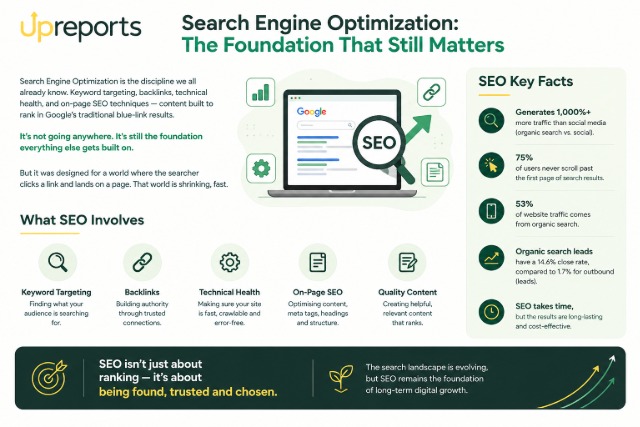
Search Engine Optimization is the discipline we all already know. Keyword targeting, backlinks, technical health, on-page SEO techniques, content built to rank in Google’s traditional blue-link results. It’s not going anywhere. It’s still the foundation everything else gets built on. But it was designed for a world where the searcher clicks a link and lands on a page. That world is shrinking, fast.
What Is GEO?
The next contender in our AEO vs SEO vs GEO battle is Generative Engine Optimization. A practice of structuring content so AI systems – ChatGPT, Gemini, Perplexity, Claude, Google AI Overviews – actually cite your brand when they generate an answer. Optimizing for a ranking position in a list? No, you’re optimizing to be source an AI model pulls from when it writes its response.
GEO for website isn’t a niche concern anymore. According to Erlin AI, ChatGPT alone reached roughly 900 million weekly active users as of February 2026. This number is up from 400 million just a year earlier. That’s not a side channel. That’s a search engine in its own right. And it plays by different rules than Google ever did.
Here’s the part that should genuinely concern any SEO-only team: fewer than 10% of sources cited in ChatGPT, Gemini, and Copilot answers actually rank in the top 10 Google organic results for the same query (per the same Erlin.ai research).
Read that twice. The signals that get you ranked have almost nothing to do with the signals that get you cited. Two different games. Two different scoreboards!
What Is AEO?
Answer Engine Optimization is the third contender in GEO vs SEO vs AEO battle. Closely related cousin to GEO – optimizing content specifically to be pulled into direct-answer formats: featured snippets, voice search results, “People Also Ask” boxes, and increasingly, the same AI-generated answers GEO targets.
In practice, the two overlap heavily. Some marketers treat AEO as tactical layer (structuring actual answer) and GEO as strategic umbrella (earning citation and authority across AI systems generally). Others use the terms almost interchangeably. Don’t lose sleep over the boundary – focus on what both demand: clear, direct, extractable answers.
GEO vs SEO: Where They Actually Diverge
This is the comparison everyone actually wants clarity on. So let’s make it concrete!
- SEO optimizes for ranking position. GEO optimizes for citation inclusion.
- SEO success looks like “we’re #3 for this keyword.”GEO success looks like “ChatGPT mentioned our brand when someone asked this question.”
- SEO relies heavily on backlinks and domain authority (off-page SEO techniques, to be precise). GEO leans more on structured, fact-dense, easily extractable content. And increasingly, on entity-based SEO, where being clearly recognized as a distinct, authoritative entity around a topic matters more than which page ranks where.
- SEO traffic shows up in Google Analytics as a session. GEO traffic often shows up as a citation you have to actively track since the searcher may never click through at all.
They’re not rivals fighting for the same budget line. They’re complementary systems that happen to draw from a lot of the same raw material. Which is exactly why so many marketers conflate them.
GEO vs SEO vs AEO: So Do You Actually Need All Three?
Short answer: yes but not in equal measure. And not all at once.
Peer-reviewed research from Princeton, Georgia Tech, and the Allen Institute for AI found that content using specific optimization methods – citing sources, adding statistics, including direct quotations – saw AI visibility improve by 30-40% compared to unoptimized content. That same research noted 47% of brands still have no GEO strategy at all heading into 2026.
That gap is your opportunity window, and it won’t stay open forever. Practically, here’s how to think about sequencing:
- SEO first, always. GEO strategy content still needs to be findable and crawlable. Generative engines often pull from content that already ranks reasonably well – SEO remains the foundation, not a separate track.
- Layer GEO tactics on top of your best-performing, most authoritative content. Don’t start from zero. Start from what already works.
- Treat AEO formatting as a habit and not a separate project. Every piece of new content should be structured to answer questions directly, regardless of which acronym you’re technically optimizing for.
Building an Actual GEO Content Strategy
If you’re ready to move past theory, here’s what a real GEO content strategy looks like in practice:
- Lead with the direct answer. Put core fact or definition in the first two sentences of any section. AI systems extract answers. Not narrative build-up.
- Add statistics, quotes, and named sources generously. This is the single highest-leverage tactic the research points to. Also, easiest one to implement immediately.
- Structure for entities, not just keywords. Your brand, products, expertise – make sure they are clearly and consistently described across your site and third-party mentions. This is what entity-based SEO actually means in practice.
- Keep content fresh. AI Overview citations skew heavily toward recently updated material. According to Seer Interactive research by Mersel AI, recently refreshed content appears roughly 4.3 times more often in AI answers than stale pages. Meaning, an old blog post sitting untouched since 2023 is quietly losing citation ground even if its ranking hasn’t moved.
- Build genuine third-party mentions. Since AI systems pull from a much wider pool of sources than the traditional top 10, digital PR and industry mentions now double as a legitimate AI citation strategy.
- Use structured data and schema markup. It helps every engine – traditional and generative – understand exactly what your content is and does.
The Adoption Gap Nobody’s Talking About Enough
Here’s the number that should actually move your budget conversation forward. Omnibound has to say that 92% of marketers say they plan to optimize for AI search but only 40.6% are currently doing anything about it. That’s more than half the industry sitting on intention without execution.
That gap is exactly where the opportunity lives. Every month spent “planning to get to it eventually” is a month competitors who moved first get to bank citations, entity recognition, and AI-driven trust that’s genuinely hard to displace once established.
Quick Recap, In Case You Skimmed
If you only remember one thing from all of this, make it these three lines:
- SEO gets you ranked in traditional search results.
- AEO gets your content formatted to win direct-answer boxes and voice results.
- GEO gets your brand cited inside AI-generated answers from tools like ChatGPT and Gemini.
All three feed off the same foundation – clear, credible, well-structured content. Which is exactly why building one properly makes the other two easier. Not harder!
None of this matters much if the site underneath it isn’t built right in first place. If you’re setting up a new site (or auditing old one), this video from us covers practical tips to make sure it’s SEO-friendly from the ground up – the foundation all three of these strategies sit on:
GEO vs SEO vs AEO FAQs
Is GEO replacing SEO?
No. GEO builds on top of SEO – most AI engines still lean on content that already has some SEO foundation. Think of GEO as a new layer, not a replacement.
What’s actual difference between AEO and GEO?
AEO focuses on winning direct-answer formats like featured snippets and voice results. GEO focuses on getting cited inside AI-generated answers from tools like ChatGPT and Gemini. They overlap heavily but aren’t identical.
Do I need to rank #1 on Google to get cited by ChatGPT?
No, research shows fewer than 10% of AI-cited sources rank in Google’s top 10 for the same query. Ranking helps, but it’s not a requirement for AI citation.
How do I know if GEO is working?
Track brand mentions and citations inside AI tools directly (ask ChatGPT or Perplexity questions related to your industry), alongside branded search volume and referral traffic from AI platforms.
Is entity-based SEO the same as GEO?
Not exactly. Entity-based SEO is one of the tactics that supports GEO. It’s about making sure your brand is clearly and consistently recognized as an authority on a topic, which helps AI systems trust and cite you.
Which should I prioritize first: SEO, AEO, or GEO?
Start with SEO as your foundation, layer AEO-style formatting (direct answers, structured content) into everything you publish, then build GEO tactics – citations, statistics, fresh content – on top of your best-performing pages.
GEO vs SEO vs AEO: The Bottom Line
SEO, GEO, and AEO aren’t rival strategies fighting over the same slice of budget. They’re three layers of the same goal – being found, being understood, and now, being cited across every surface where people actually look for answers in 2026.
Ranking still matters. But if that’s the only game you’re playing, you’re already missing where a huge share of buying decisions now start: inside an AI-generated answer you were never in the room for.
Ready to Build an AI Search Strategy That Covers All Three?
Figuring out where SEO ends and GEO begins – and building content that actually performs across both – isn’t a side project you tackle in spare time. It takes a strategy built specifically for how people search now, not how they searched five years ago.
That’s exactly what Upreports helps businesses do. We build content and technical strategies that rank in traditional search, get structured for AI citation, and keep your brand recognized as the authority worth quoting, whether the searcher is on Google or asking ChatGPT directly.
If your team is part of the 92% planning to catch up on AI search, let’s turn that plan into action. Reach out to us at hello@upreports.com.
Our digital marketing agency is also popular for:
Enterprise SEO services in India
White label SEO services in India

Vivek Khullar
Vivek Khullar is a content creator who manages everything content for our clients. With 7+ years of work experience, he helps clients with content strategy, blogging, website content, creative content, and promotional material. Vivek can be found on his gaming console if nowhere else.