
More than half of all Google searches now end without anyone clicking anywhere. Not on your site. Not on a competitor’s. Nowhere. Welcome to the world of zero-click searches where ranking 1st used to mean traffic and now it sometimes just means… nothing happened.
If our statement just made your stomach drop a little, good. It should. But hey, panic isn’t a strategy. And neither is pretending it isn’t happening. What actually works is understanding exactly why this shift occurred and building a plan that wins visibility even when the click never comes.
That’s what we’re going to do today. No fluff. No “oh, just write better content” hand-waving. Upreports is here to share actual step-by-step approach!
Picture this. Someone Googles what’s the difference between HTML and CSS? Ten years ago, they’d click into 3-4 blog posts, compare explanations, and eventually land on the one written clearest. Today? Google’s AI Overview answers it right there in 4 tidy sentences. It sources them from somewhere you’ll never see unless you go digging.
The searcher gets their answer. Nobody visits your site. And unless you were the one cited in that summary, you don’t even get credit for trying.
That’s the new reality. Let’s build a strategy for it!
What Is Zero-Click Search Exactly?
Simple definition first. A zero-click search happens when someone types a question into Google and gets their answer right there on the results page. Visiting the website – what’s that? Weather, definitions, quick math, sports scores… and now, thanks to AI Overviews, a whole lot more.
In past, zero-click results were mostly reserved for simple factual queries. Now? AI-generated summaries answer complex, nuanced questions that used to require reading 3 different blog posts to piece together. That’s a much bigger chunk of search real estate disappearing from your traffic reports.
Why Is This Happening?
Here’s the honest, slightly uncomfortable truth: Google’s AI Overviews are the single biggest driver of zero-click surge. And no, they’re not slowing down.
According to a 2026 breakdown of Google search data by Thestacc, AI Overviews now trigger on approximately 48% of all tracked search queries. Organic click-through rate drops somewhere between 34% and 61% whenever one shows up. Read that range again. Even on low end, you’re losing a 3rd of clicks you used to count on. On high end, you’re losing nearly two-thirds.
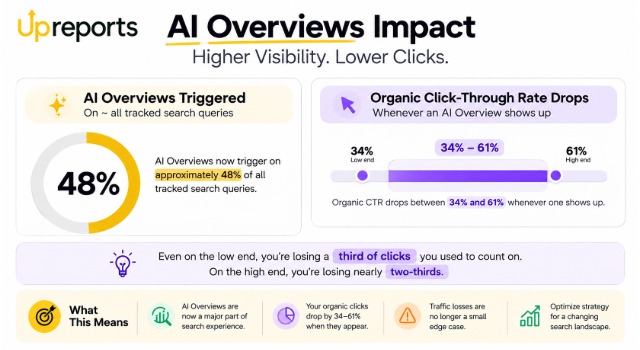
Ranking problem? No, your position hasn’t moved. It’s just the floor that shifted underneath it.
And this isn’t a niche issue affecting a single industry while the rest of us watch from sidelines. Healthcare, education, B2B tech – informational-heavy industries are seeing AI Overviews on vast majority of their searches. If your content answers questions (and truth be told, most content marketing does), you’re in the blast radius.
Upreports’ SEO services in India will help you dominate rankings and AI Overview citations so you stay visible even when searches end without a click.
Stat That Explains This Anxiety
Felt like organic traffic has been quietly declining even while rankings look fine? You’re not imagining it. A recent aggregation of search behavior data by Omnibound found that zero-click rates have climbed from roughly 56% to 69% since AI Overviews first launched. That’s not a gradual dip. That’s a jump of over a decade’s worth of change happening in a couple of years.
Here’s the part that should reframe how you think about all of this though. A zero-click search isn’t automatically a loss. It’s a different kind of win. If you’re positioned to be source that gets cited, quoted, or trusted enough that searcher remembers your brand name even without clicking through.
Old scoreboard measured clicks. New one has to measure something closer to impression and trust.
The question is how do you actually get positioned for that? Let’s get into the steps!
Step 1: Optimise for Search Intent That Actually Triggers AI Overviews
Not all queries are created equal here. This matters more than most people realise. AI Overviews don’t show up evenly across search types. They cluster heavily around certain intents.
Comparison-style searches (say, X vs Y format) trigger AI Overviews a staggering 95.4% of the time. Question-format queries, on the other hand, sit at 85.9%. And review-related searches? Well, they’re at 86.3%. No, we aren’t making up these numbers. It was discovered by SQ Magazine in their 2026 analysis of nearly 50,000 queries.
Meanwhile, purely commercial queries trigger them only 8% of the time. Transactional ones just 5%.
What does this means, you ask? That if you’re writing product A vs product B comparisons, in-depth guides, or review content, you’re playing directly in AI Overview territory (whether you planned to or not). That’s not necessarily bad news. It just means your content needs to be structured to win the citation. Not just the ranking.
What to actually do:
- Build comparison content deliberately .It’s almost guaranteed to surface an AI Overview
- Answer literal question in first two sentences before you get clever with the intro
- Use question-based subheadings that mirror how people actually search
- Stop optimizing purely for short head terms. Longer, more specific queries are where AI Overviews concentrate
Don’t forget to check out these resources:
Click-through rate booster tips
AI marketing tools for SEO, content, and design
Step 2: Structure Content So AI Systems Can Actually Cite You
Getting cited inside AI Overview isn’t about being the flashiest writer. It’s about being the easiest source to extract a clean answer from. AI systems pull information the way a busy person skims. Fast, structurally, without patience for buried answers.
That means:
- Lead with the direct answer, then explain the nuance afterward
- Use genuine headers that match real search phrasing, not cute wordplay
- Keep paragraphs short enough to extract as a standalone thought
- Add structured data and schema markup. This way, search engines will understand your content’s format and not just its topic
- Include specific numbers, dates, and named sources. Vague content doesn’t get cited, credible content does
Here’s an underrated tip: read your own content the way an AI summarization tool would. If you had to pull one sentence out of each section to represent the whole thing, would that sentence actually make sense on its own? If not, restructure until it does.
Best content marketing services in India structure answer-first, extractable content that AI systems actually cite and pull into zero-click results.
Step 3: Build Brand Mentions Everywhere, Not Just on Your Own Site
This is the part that trips up a lot of SEO-first teams. AI Overviews don’t only pull from page-one rankings anymore. Citations are increasingly coming from a much wider pool of sources than they used to.
Only a fraction of AI Overview citations now come from pages ranking in the traditional top 10. A huge shift from just a couple of years ago if you think about it. Also, nearly 30% of all mentions go to a relatively small set of top domains, according to data compiled by Heroic Rankings.
The same research also found that 63% of businesses reported a positive effect on their organic visibility since AI Overviews rolled out. A proof that this isn’t purely a story of loss.
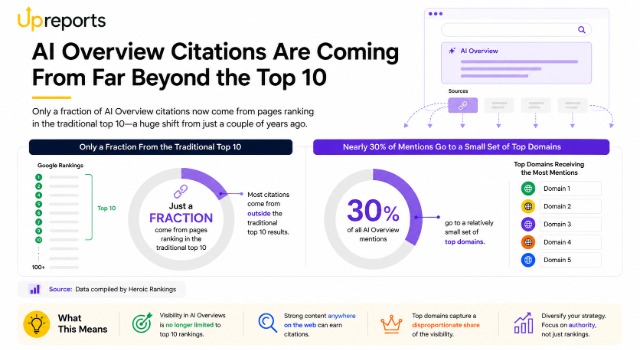
So what exactly does that tell us? Authority now gets built across a wider footprint. Being mentioned on industry publications, cited on forums, referenced in comparison roundups, quoted in third-party reviews – all feed into whether AI systems consider you a trustworthy answer. Digital PR, guest content, community presence – they aren’t extra anymore. They’re part of the actual optimization strategy!
What to actually do:
- Pursue genuine mentions and backlinks from industry-relevant publications. Not just any site with high domain authority
- Get your brand discussed in forums, review sites, and comparison content where your category gets searched
- Make sure your own site’s information is consistent everywhere it’s mentioned. Mismatched facts confuse both AI systems and readers
- Treat digital PR as a search visibility tactic, not just a brand awareness one
Top brand building services grow the mentions, authority, and trust signals across the web that make AI engines choose and remember your brand.
Step 4: Track Metrics That Actually Reflect Reality Now
Still reporting on organic sessions as your only headline metric? Then you’re telling half the story… maybe less. It’s time to track visibility beyond the click.
Here are some metrics worth watching:
- Impression share and SERP visibility. Even for queries where clicks have dropped
- Branded search volume – are more people searching your company name directly after being exposed to your content elsewhere?
- Citation frequency in AI Overviews and answer engines where tools now exist to monitor this
- Assisted conversions where someone saw your brand in an AI summary days before converting through a direct search
- Featured snippet ownership. Since these often overlap with AI Overview real estate
None of this replaces your existing SEO dashboard. It sits alongside it. You should think of clicks as one data point in a much bigger visibility picture. Not the entire picture itself!
Notice how a lot of these metrics – branded search volume, citation frequency, being remembered even without a click – all trace back to one thing: how strong your brand identity actually is.
The stronger and more recognizable your brand, the more of these numbers move in your favor. If you’re figuring out where to start on that front, this video from Upreports walks through practical tips and ideas for building a brand online worth remembering:
Zero-Click Search FAQs
Is zero-click search bad for my business?
Not automatically. It’s bad if you have no strategy for it. You should think of it as opportunity as you can get positioned as the cited, trusted source people remember even without clicking.
Should I stop creating informational content since AI Overviews eat those clicks?
No. That would be the fastest way to disappear entirely. Informational content is exactly where AI Overviews pull their answers from. Walking away means someone else gets cited instead of you.
Does this mean SEO doesn’t matter anymore?
It actually means SEO alone isn’t the whole picture. Rankings still matter for the clicks that remain, yes. But visibility now extends beyond traditional blue links into AI summaries, snippets, and citations.
How long until this stabilises?
Search behaviour data suggests AI Overview coverage is still expanding. It won’t be shrinking. Building a citation-first strategy now beats waiting for things to “go back to normal” – they won’t.
Zero-click Search: Final Words
Zero-click search isn’t a temporary glitch. You don’t have to wait it out. It’s actually the new shape of search. Not reversing course. But hey, no click doesn’t have to mean no value. The brands winning in this environment have stopped treating every search interaction as a traffic event and started treating it as a trust event. One where being cited, mentioned, and remembered matters just as much as being clicked.
Rankings got you noticed. Visibility strategy gets you remembered. This year, you need both! Need help building this strategy? Restructuring content for AI citations, building brand mentions across the web, tracking visibility metrics that don’t even show up in Google Analytics by default – that’s a lot to take on alongside everything else your team already handles.
That’s exactly where Upreports comes in. We help businesses build search strategies designed for how people actually search today – structuring content to win AI citations, building the kind of brand presence that gets picked up across the web, setting up tracking that tells you the truth about your visibility. Not just your click count.
If you’re tired of watching rankings stay strong while traffic quietly slips, reach out to us at hello@upreports.com. Let’s work together and build a strategy that wins whether the click happens or not.

Vivek Khullar
Vivek Khullar is a content creator who manages everything content for our clients. With 7+ years of work experience, he helps clients with content strategy, blogging, website content, creative content, and promotional material. Vivek can be found on his gaming console if nowhere else.